Best Way to Handle After-Hours Enquiries
The best way to handle after-hours enquiries: acknowledge every call, form and message within minutes, and know exactly which ones need a human right away.

TL;DR
The best way to handle after-hours enquiries is to acknowledge every one of them — call, form, WhatsApp message or email — within minutes, resolve whatever's routine on the spot, and get anything genuinely urgent in front of a real person straight away. Most businesses only plan for after-hours phone calls and leave every other channel to sit until Monday, which is exactly where the highest-intent enquiries of the week quietly go cold. Here's how to actually cover all of them, not just the ones that ring.
Why after-hours enquiries are worth more than the ones you get at 2pm
A customer who gets in touch at 9pm on a Tuesday isn't idly browsing. They've had a problem all day, finally sat down, and decided to act on it. That's a warmer lead than most of what arrives during business hours — and it's arriving at precisely the moment nobody's there to answer it.
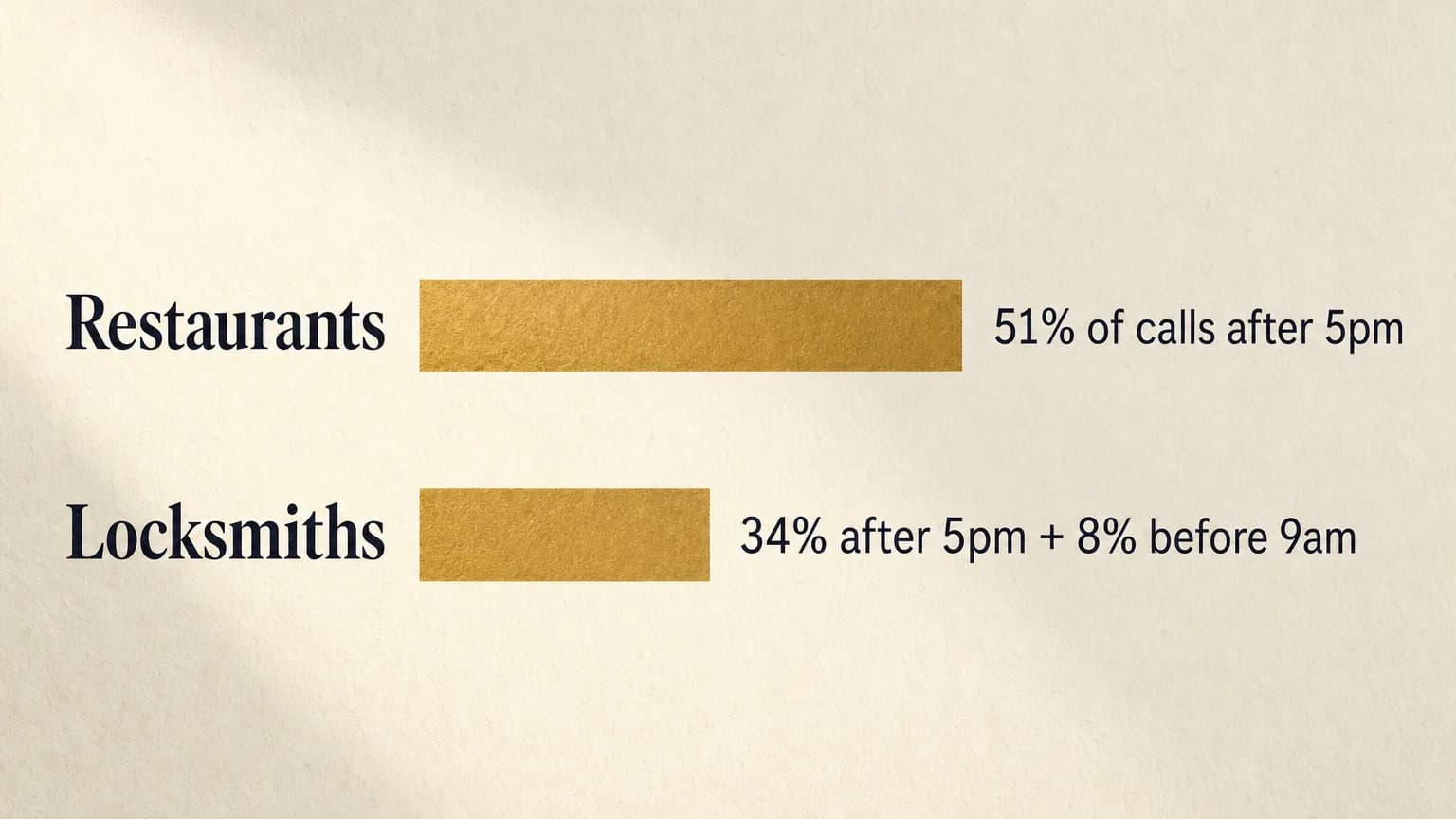
This isn't a fringe slice of the week either. In BrightLocal's study of 45,000 local-business listings, restaurants received 51% of their calls after 5pm, and locksmiths took 34% after 5pm plus a further 8% before 9am. Swap "restaurant" or "locksmith" for whatever service you run and the shape holds: a large chunk of demand simply doesn't arrive during opening hours, because your customers have their own working day to get through first.
Speed matters as much as coverage. The widely-cited Harvard Business Review lead response study found that the odds of properly qualifying a lead drop roughly 21x if you wait 30 minutes instead of 5. That statistic gets quoted for daytime sales leads, but it applies at least as hard at 9pm — the customer isn't going to sit on their sofa for 12 hours waiting for your reply. They'll ring, message or fill in a form on the next business that's actually paying attention.
What actually counts as "after hours" once you count every channel
Most after-hours advice is written as if the only enquiry that matters is a phone call. It isn't. A growing business today gets contacted through at least four channels, and each one can go quiet the moment the working day ends:
- Phone calls — the classic case, and the one most owners have at least thought about.
- Web forms — submitted, then sitting in an inbox nobody checks until Monday.
- WhatsApp and website chat — increasingly the first channel people reach for, especially for trades and bookings.
- Email — slower by default, but still an enquiry someone is waiting on.
If your after-hours plan only covers the phone, you've solved a quarter of the problem. A visitor who fills in your contact form at 10pm has shown exactly the same intent as someone who rings — they've just used a channel that's easier to leave unattended, which is precisely why so many businesses do.
The one rule that matters more than which tool you pick
Whatever mix of channels you're covering, one principle does most of the work: acknowledge fast, resolve what you can, escalate what you can't. Nobody expects a small business to have a fully staffed night shift. They do expect to know their enquiry landed and that something's going to happen next.
That's also the belief this whole guide is built on: most businesses don't actually have a lead problem, they have a follow-up problem. The enquiries are already arriving after hours — the only question is whether anything catches them before the customer moves on to whoever answers next.
The best way to handle each channel after hours
Phone calls
Voicemail is the default nobody actually chose — it's just what's left switched on. Most callers who reach it hang up rather than leave a message, and enough of the rest ring the next name on the list that a full voicemail box is closer to a leaderboard of lost jobs than a safety net.
An AI voice agent is the option that actually finishes the job: it answers on the first ring at 11pm the same way it does at 11am, handles the obvious questions, and books the appointment straight into your calendar instead of leaving you a message to action tomorrow. We go deeper on the full range of options — voicemail, an on-call rota, a human answering service, and AI — in out of hours call handling, including realistic after hours answering service cost if you're weighing up a live service specifically.
Web forms and email
A form is the easiest channel to neglect, because nothing rings and nothing feels urgent about an unread inbox. But the person who filled it in at 9pm is watching for a reply just as closely as someone waiting for a callback. The fix isn't complicated: an automated first reply within minutes that confirms the enquiry landed, followed by a proper human or AI-qualified follow-up the moment someone's available — not a generic "we'll be in touch" that says nothing.
WhatsApp and live chat
This is where a lot of growing businesses are already losing enquiries without realising it, because chat feels informal even when the intent behind it is serious. A WhatsApp AI agent can hold a natural conversation, qualify what the person actually needs, and get them booked in overnight — see WhatsApp business automation for what that setup can and can't do well. Left unattended, the same channel just becomes a message sitting under a green dot until someone finally opens the app on Monday.
Triage: what should reach a real person immediately
Not every after-hours enquiry should be handled the same way, and that's the part a lot of "just automate it" advice skips. Good after-hours handling makes a clear split:
- Routine enquiries — availability, pricing, booking a standard appointment — get answered and, where possible, booked automatically, on any channel, at any hour.
- Genuinely urgent enquiries — a burst pipe, a break-in, an emergency call-out, an already-escalated complaint — get flagged and routed to a real person straight away, day or night.
The AI's job is to be invisible in the good sense: the customer gets helped and booked, not fobbed off by something that's obviously a script. People handle judgement and the human bits; automation handles the answering, qualifying and chasing that shouldn't need a person awake for it.

A simple checklist before you decide
Whatever you land on, hold it to the same standard across every channel:
- Answers instantly — calls, forms, WhatsApp — not "usually," always.
- Sounds like your business, not a call centre script or a form-fed autoresponder that mentions three other companies.
- Can actually resolve or book, not just log the enquiry and hand the work back to you tomorrow.
- Escalates properly, so urgent enquiries reach a person immediately and routine ones don't need to.
- Covers every channel the same way, so a customer gets consistent treatment whether they called, messaged or filled in a form.
Miss any one of those and you've just built a more polite version of the voicemail box you were trying to replace.
The bottom line
The best way to handle after-hours enquiries isn't picking the single "best" channel to cover — it's making sure none of them go quiet once the office does. Voicemail, an unread inbox and a green WhatsApp dot are all the same problem wearing a different outfit: an enquiry that arrived, and nobody there to catch it. Cover all of them with the same standard — fast acknowledgement, automatic resolution where possible, a real person where it matters — and the after-hours gap stops being a gap at all. If you're not sure which channel is leaking the most right now, get in touch and we'll help you find out.
Frequently asked questions
Axivon
Stop losing leads to missed calls and slow follow-up.
Axivon builds AI voice agents, lead capture, and follow-up automation that work while you don't. See what it would look like for your business.