Is an AI Phone Agent Worth It for a Small Business?
Is an AI phone agent worth it for a small business? Real UK cost bands, the break-even sum, and the calls it genuinely shouldn't handle — no hype.

TL;DR
Short version: yes, if missed calls are genuinely costing you jobs — no, if your phone barely rings. Is an AI phone agent worth it for a small business depends entirely on your own numbers, not a universal ROI stat. UK AI answering agents typically run £25–£200 a month, well under the cost of even a part-time hire, and most businesses only need to recover a single missed job a month to break even. Below: the real cost, the break-even sum done properly, and the calls it genuinely shouldn't handle.
The real question isn't "is AI good" — it's "does the maths work for you"
Every buyer's guide on this topic eventually lands on a version of "it depends," which is true and also useless. Here's the version that isn't: an AI phone agent is worth it when the calls you're currently losing are worth more than the agent costs. That's the whole test. Everything else — how impressive it sounds on a demo call, whether it's "cutting-edge" — is noise.
So the honest starting point isn't researching AI voice agent technology. It's finding out how many calls you're actually missing right now, because that number decides the answer before you've spent a penny.
What you're actually losing by not having one
Most business owners underestimate this because a missed call leaves almost no trace. No angry email, no bad review — just a gap where a job used to be. Research across UK SMEs puts the missed-call rate at roughly 1 in 4, and a 2025 study of 142 UK small businesses found 47% of first-time calls went unanswered. Fewer than 3% of callers pushed to voicemail actually leave a message — the rest just ring the next name on the list.
Say your average job is worth £300 and you close roughly half the people who reach you. Every answered call is worth about £150. Miss five calls a week — not unusual for a busy trade, clinic or salon — and that's over £1,800 a month quietly gone. We've done this sum properly, with the working shown, in how to stop missing customer calls.
That's the number an AI phone agent has to beat, not "is this impressive technology." Most businesses find it clears that bar without much effort.
What an AI phone agent actually costs in the UK
This is where guides get vague, so here's the real range. A well set up UK AI phone agent — one that answers questions, qualifies the caller and books the appointment, not just recites a script — typically costs £25–£200 a month, priced on usage rather than a person's shift. There's no idle-time cost between calls and no reason a call at 2am should cost more to handle than one at 2pm, because nobody's being paid to sit by the phone waiting.
For comparison: a full-time receptionist costs a median £18,152 a year in salary alone according to ONS data, before employer's National Insurance and pension contributions add roughly 15–20% on top. A human answering service typically runs £65–£300 a month for business-hours cover, climbing past £300 for genuine 24/7. Ai receptionist for small business pricing, in other words, tends to undercut every human option — the fuller breakdown, with published UK provider rates, is in answering service pricing.
The break-even sum, done properly
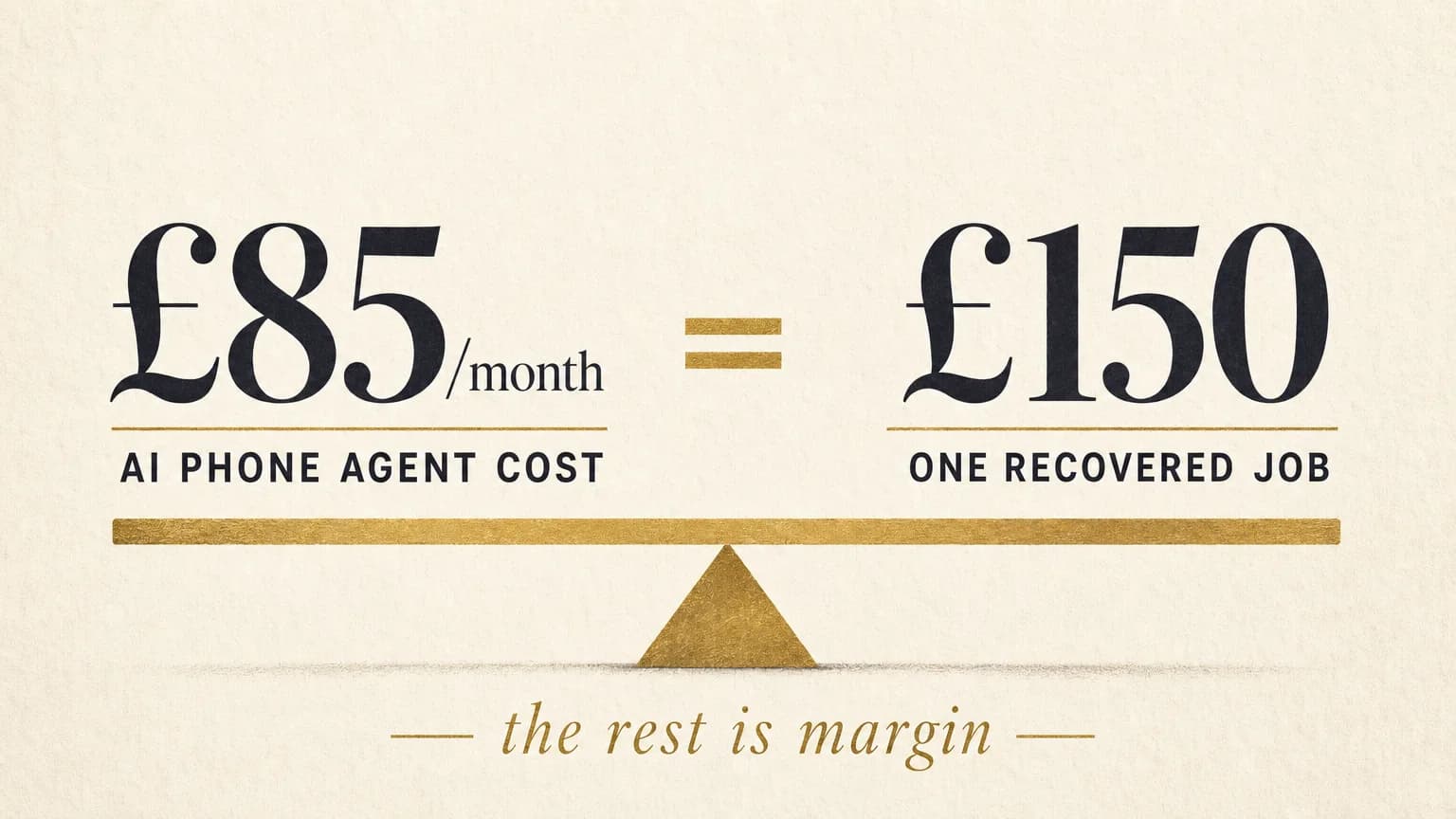
Take a mid-range figure of £85 a month — a realistic price for a decently built AI voice agent for small business use, handling FAQs, qualifying callers and booking appointments. Against the £150-per-answered-call example above, you need to recover roughly one paying job a month to break even. Everything after that first recovered call is margin, not just cost recovery.
Most businesses missing five calls a week are nowhere near that threshold — they clear it in the first week and spend the rest of the month in profit. The honest exception: if you genuinely answer almost every call already, there's very little for an agent to recover, and the maths won't favour you. That's worth checking before you buy anything, not after.
Where it earns its keep fastest
The businesses that get the clearest return share a pattern: the calendar is the engine of revenue, calls are frequent and mostly routine, and a fair share land outside office hours. Think trades, clinics, salons, and service businesses where "can I book Thursday?" is a normal call, not an edge case.
Do AI phone agents work well here? Genuinely, yes — because most of what they need to do is answer a known set of questions and get a slot in the diary, which is exactly the kind of structured, low-ambiguity task voice agents are good at. The busier and more repetitive your call pattern, the faster the agent pays for itself.
Where it doesn't pay off — being honest about it
AI is genuinely useful here, but it isn't set-and-forget magic, and pretending otherwise does nobody any favours. A phone agent doesn't earn its cost if:
- Your call volume is genuinely low and you rarely miss one already — there's little to recover.
- Most of your calls are emotionally complex — a distressed customer, a sensitive complaint, a negotiation that isn't really about the stated question. Those need a person, not a script, however well-briefed.
- You expect it to replace judgement, not just availability. The goal is a caller who gets helped and booked, invisibly — not "look, a robot answered."
None of that makes it the wrong tool. It makes it the wrong tool for those specific calls. Most businesses run a hybrid: the agent answers first, handles what's routine, and hands anything genuinely tricky to a person — which is how we set up Axivon's AI voice agents by default.
How to tell if it's worth it for your business
A short, practical checklist before you spend anything:
- Pull your real call volume for a fortnight. Most phone systems log missed calls — check the actual number, not a guess.
- Work out what one answered call is worth. Average job value × close rate gets you close enough.
- Multiply missed calls by that figure. That's your monthly leak, and the number the agent has to beat.
- Check the shape of your calls. Mostly routine (hours, pricing, booking) favours AI. Mostly emotionally complex favours keeping a human on the line.
- Compare that leak against a realistic UK price — £25–£200 a month for a properly built agent, per the numbers above.
If the leak is bigger than the cost, the answer to "is it worth it" is yes before you've made a single call to a provider.
The bottom line
Whether an AI phone agent is worth it for your small business isn't a question about AI — it's a question about your own missed-call number against a genuinely affordable UK price band. For most businesses answering fewer than every call, the maths clears easily: one recovered job against £25–£200 a month is rarely a close call. For a business that already answers reliably and handles mostly sensitive conversations, the case is weaker, and that's worth knowing before you buy rather than after.
If you want to see the actual number for your business rather than a rule of thumb, take a look at our AI voice agents or get in touch and we'll work the maths with your real call volume. And if calls are only part of where things are slipping, the Revenue Leakage Review scans the whole customer journey and tells you which gap is actually costing you most.
Frequently asked questions
Axivon
Stop losing leads to missed calls and slow follow-up.
Axivon builds AI voice agents, lead capture, and follow-up automation that work while you don't. See what it would look like for your business.