How to Stop Missing Customer Calls
Missed calls quietly cost you jobs every week. Here's why they happen, what each one is really worth, and how to answer every call without hiring.

TL;DR
You're probably losing about 1 in 4 calls to voicemail — and most of those callers don't leave a message, they ring your competitor. Each missed call is a missed job, and the maths adds up faster than you'd think. You don't fix it by "trying to be better at answering the phone." You fix it by making sure something reliable answers every call, even at 7pm on a Saturday. Here's the what, the why, and the how.
The quiet leak most businesses never measure
Here's the uncomfortable bit: most owners have no idea how many calls they miss, because a missed call leaves almost no evidence. There's no angry email. No one-star review. Just a gap where a job used to be.
Research across small businesses puts the missed-call rate at roughly 25% — and if you spend your day on a job site, in a treatment room, or driving between appointments, it's higher. The phone doesn't wait until you're free. It rings when you're elbow-deep in the actual work.
And the old fallback — "they'll leave a voicemail" — stopped being true years ago. The vast majority of callers hang up the moment they hear a greeting and simply call the next name on the search results. Your voicemail box isn't a safety net. It's a list of people who've already gone elsewhere.
What a single missed call is actually worth
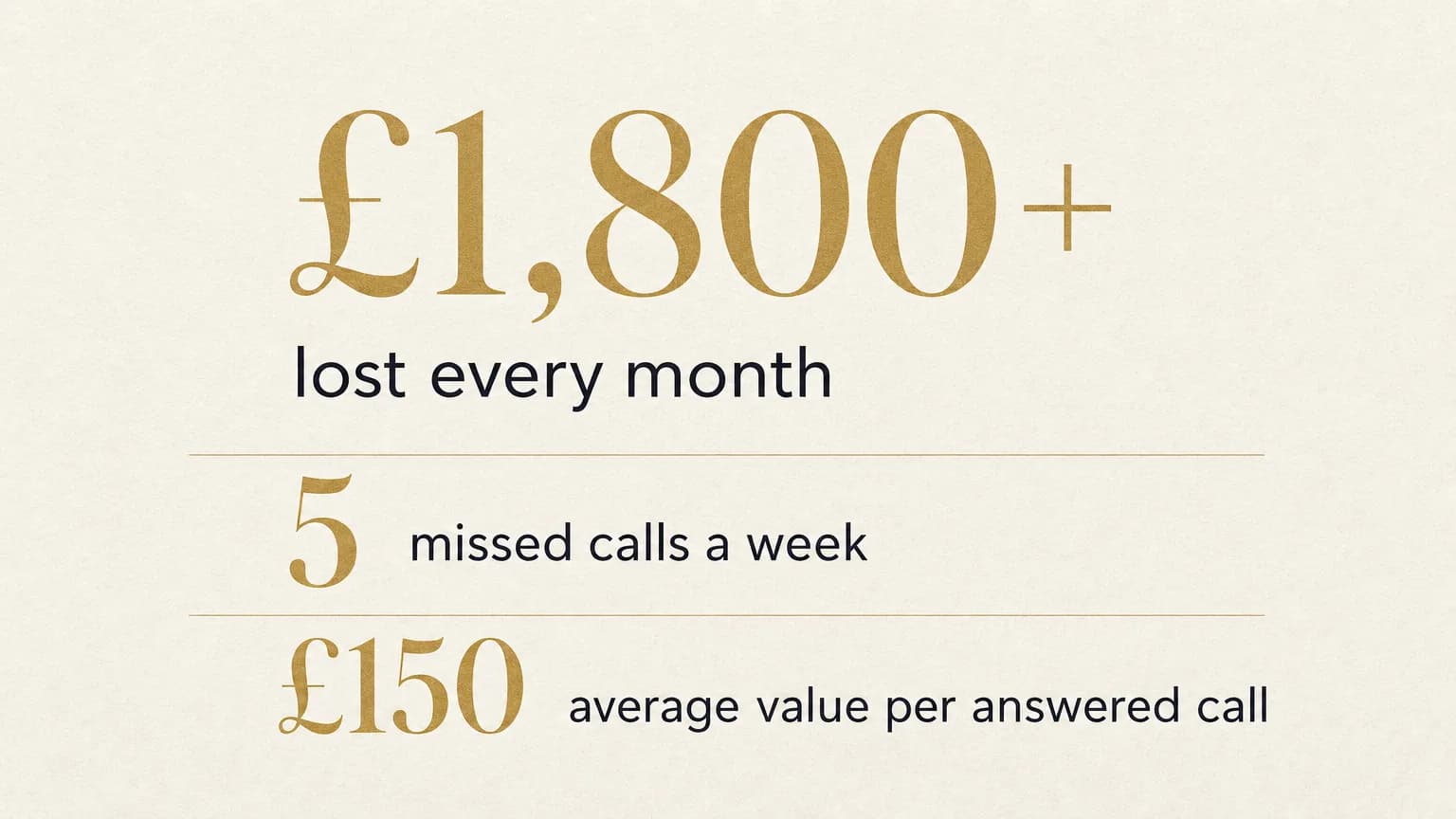
Let's do the sum nobody wants to do. Say your average job is worth £300, and you close half the people who reach you. That means every answered call is worth about £150 in expected revenue.
Now say you miss five calls a week — modest for a busy trade or clinic. That's 25 lost conversations a month. Even if only half would have become customers, you're looking at well over £1,800 a month vanishing into voicemail. A year of that buys a van. Or a very nice holiday you'll be too busy to take, because you're answering the phone.
The point isn't the exact number — it's that the leak is large, invisible, and completely fixable.
Why "just answer more" never works
The instinct is to try harder: keep the phone closer, promise yourself you'll pick up. It never lasts, because the problem isn't discipline — it's physics. You can't be on a ladder and on the phone at the same time. You can't take a call mid-consultation. And you certainly can't answer at 9pm when a customer finally sits down to sort out their problem.
The three gaps that swallow calls:
- The busy gap — you're already with a customer or on the tools.
- The after-hours gap — a huge share of enquiries land evenings and weekends, exactly when nobody's at the desk. Proper after hours call answering captures these instead of losing them to Monday. If that's your biggest leak, we've compared the four realistic ways to cover it in out of hours call handling — and calls are only one channel; see the best way to handle after-hours enquiries across forms and WhatsApp too.
- The overflow gap — two calls at once, and one always loses.
Hiring a receptionist fixes some of this and creates new problems: salary, holiday, sick days, and they still go home at 5pm.
How to answer every call without hiring
This is where the maths gets fun. You don't need a bigger team — you need a front door that's always open. A few options, worst to best:
- A call answering service. Humans in a call centre take a message. Better than voicemail, but you're paying by the minute, callers still wait on hold, and "we'll pass your message on" isn't a booking.
- A basic voicemail-to-text. Marginally less useless than plain voicemail. The caller has still hung up and moved on — and fewer than 3% of them leave a message in the first place.
- An AI voice agent. It picks up on the first ring, every time, 24/7. It greets the caller in your business's voice, answers the common questions ("do you cover my area?", "how much roughly?", "how soon can you come?"), qualifies them, and books the appointment straight into your calendar.
An AI voice agent doesn't get overwhelmed by two calls at once, doesn't take lunch, and costs a fraction of a human hire. The caller gets helped in seconds. You get a booked job and a text summary. Nobody's stuck listening to hold music that sounds like it was recorded underwater.
And the calls it can't fully handle? It routes or captures them so you can follow up fast — which, as we've written before, is the whole game with leads: speed wins the work. How much it wins by is worth knowing — the five-minute rule behind speed to lead is one of the better-evidenced numbers in sales.
A quick reality check before you buy anything
AI voice agents are genuinely good now, but they're not fairy dust. To actually plug the leak, make sure whatever you use:
- Answers instantly, including nights and weekends.
- Sounds natural and on-brand, not like a robot reading a script from 2011.
- Can book, not just "take a message."
- Sends you a clean summary of every call so nothing falls through.
Get those four right and the 1-in-4 leak closes. Get them wrong and you've just bought a fancier voicemail.
The bottom line
Missed calls are the cheapest problem in your business to ignore and one of the most expensive to actually have. You won't out-discipline a ringing phone while you're doing the work that pays. Put something reliable on the front door, measure what changes, and watch how many "we went with someone else" moments quietly disappear.
If you've done the sum above and you're wondering whether the fix is actually worth paying for, we've run that maths properly — with real UK price bands and the break-even point — in is an AI phone agent worth it for a small business.
The same silent-leak problem shows up at the other end of the booking, too — an appointment nobody turns up to is just a missed call in reverse, and just as fixable. We've covered the playbook in how to reduce no-show appointments.
If you'd like to see what that looks like for your business, that's exactly what we build — have a look at our AI voice agents or get in touch. And if you'd rather know the size of the leak before plugging it, the Revenue Leakage Review puts your own numbers against the maths above.
Frequently asked questions
Axivon
Stop losing leads to missed calls and slow follow-up.
Axivon builds AI voice agents, lead capture, and follow-up automation that work while you don't. See what it would look like for your business.