How Much Does an AI Receptionist Cost in the UK?
How much does an AI receptionist cost in the UK? £30-£300 a month for off-the-shelf plans, £2,000+ for custom builds, and the fees pricing pages leave out.

TL;DR
How much does an AI receptionist cost? Most UK small businesses pay £30-£60 a month for a basic AI receptionist (greeting, message-taking, simple routing), £60-£150 for one that books appointments and answers real questions, and £150-£300 for full-featured plans with 24/7 cover and CRM sync. Multi-channel or custom-built setups run £300-£2,000+ a month, often with a £2,000-£4,000+ upfront build fee. Below: the three ways you're actually billed, what pushes the price up, the hidden fees pricing pages don't lead with, and how it stacks up against hiring or a traditional answering service.
Why the headline number is never the whole story
Type "how much does an AI receptionist cost" into Google and you'll get answers ranging from around £14 a month — the genuine entry-level floor listed on independent software marketplace Capterra — up to £2,000. Both are real. Both describe genuine products. Neither tells you what you'll actually pay, because the price depends on four things that vary business to business: how many calls come in, what the AI needs to do once it answers, how many systems it has to talk to, and whether you're buying a ready-made platform or a bespoke build.
We're an AI agency that builds voice agents for a living, so we've priced enough of these to know where the real numbers land — and where the marketing rounds them down. This is that breakdown.
Whether you searched AI receptionist pricing, AI answering service pricing, virtual receptionist pricing UK, or AI voice agent pricing, you'll land on the same three-tier reality — most guides just use different words for the same three billing models.
If you're still weighing up whether an AI receptionist beats hiring someone, is an AI phone agent worth it for a small business covers that decision first. If cost is the only question left, read on.
The three ways you actually get billed
Strip away the branding and almost every AI receptionist is priced one of three ways.
Per-minute
You pay for time spent on the call, typically 20p to 45p a minute within your plan's included allowance, rising to £1-£2 a minute once you go over. This rewards short, simple calls and costs more for anyone whose customers like to talk things through.
Per-call (flat rate)
A fixed amount per answered call, usually 60p to £2 within an allowance, climbing to £2-£9 a call on overage. Predictable per call, less predictable across a month with fluctuating volume.
Monthly subscription
A set fee — commonly £25 to £300 for off-the-shelf plans — covering a bundle of calls or minutes, with the same overage math above once you exceed it. This is the default structure for most providers, for the same reason it's the default for phone contracts: predictability sells better than a running meter.
The trap is the same one that catches out traditional answering services: pay for a 200-call bundle and use 80, and your real cost per handled call has more than doubled. Check the allowance against your actual volume, not the headline number.
Off-the-shelf vs custom-built: what changes the price
This is the split most pricing guides skip, and it's the one that actually explains the £14-to-£2,000 spread.
Off-the-shelf platforms are pre-built software you configure yourself or with light onboarding help — you pick a template, feed it your hours and services, and it goes live. These sit in the £25-£300 a month range depending on tier, and the appeal is speed: live in days, not weeks.
Custom-built AI receptionists are configured around your specific business logic — multi-step booking rules, several calendars, escalation paths for different call types, integration with whatever CRM you already run. Expect £2,000-£4,000+ for the initial build and £100-£300+ a month to run it. The extra cost buys a system that actually matches how your business works, rather than one you've bent your process to fit.
Neither is inherently the right answer. A single-location business with routine calls is usually well served off-the-shelf. A business with multiple locations, several call types, or deep CRM requirements tends to outgrow the template fast enough that a proper build pays for itself.
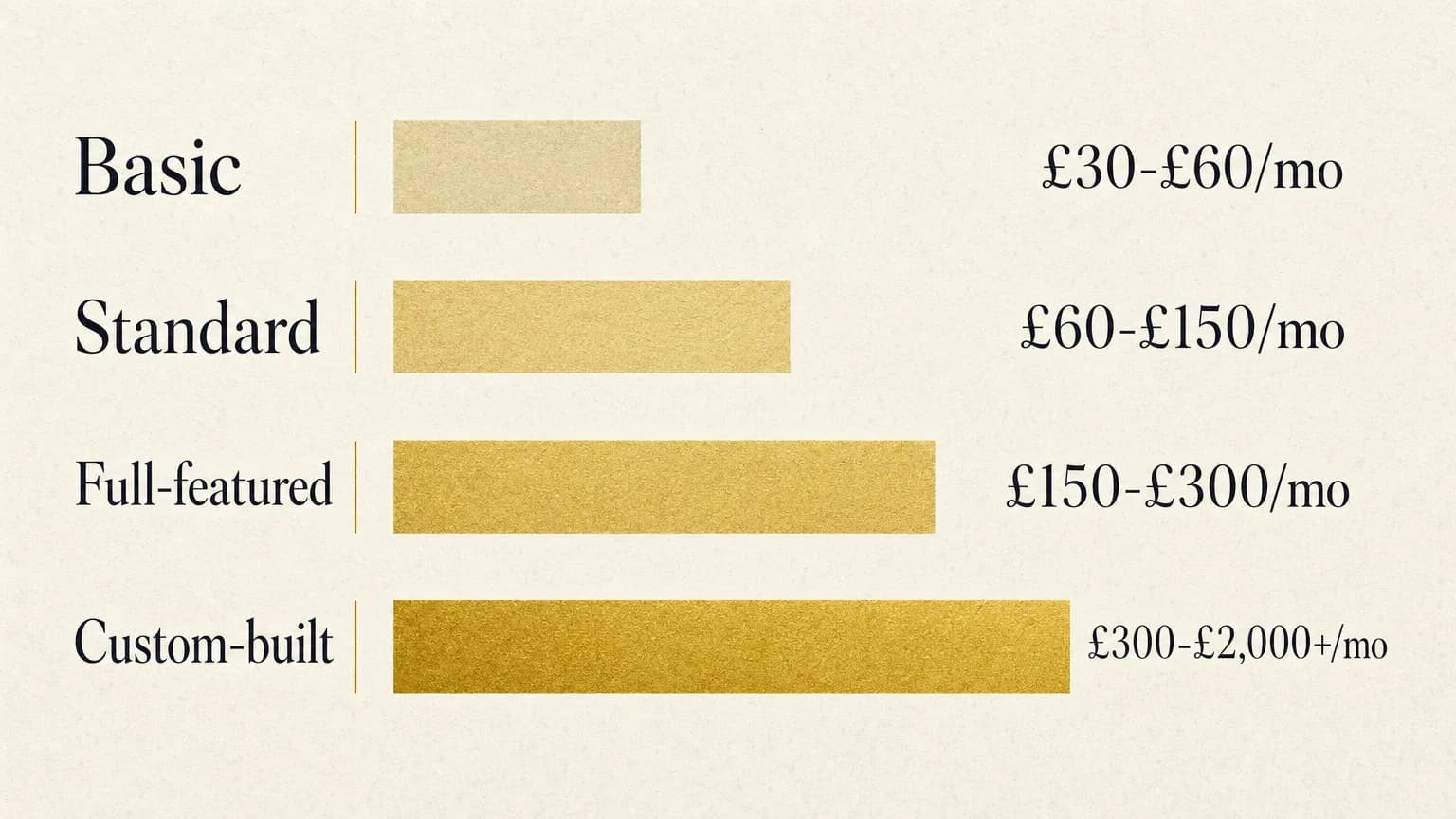
Realistic UK price bands: what an AI receptionist actually costs
Putting the numbers against what you actually get:
| Tier | Typical monthly cost | What you get |
|---|---|---|
| Basic | £30-£60 | Greeting, message-taking, simple call routing |
| Standard | £60-£150 | Answers real questions, books appointments, calendar sync |
| Full-featured | £150-£300 | 24/7 cover, CRM integration, multiple lines, priority routing |
| Custom-built / multi-channel | £300-£2,000+ | Bespoke logic, phone + WhatsApp + web chat, dedicated build |
Most owner-operated businesses with a single phone line and routine enquiries land in the Standard-to-Full-featured band. The jump to Custom-built is usually driven by complexity, not size — a single-site business with three call types and a fussy old booking system can outspend a five-site business with one simple diary.
What actually drives the price up or down
Five things move the number more than anything else:
- Call volume. More calls means more usage on per-minute or per-call plans, or a bigger bundle needed on a subscription plan.
- What it needs to do. Taking a message is cheap. Checking live availability, quoting a price, and booking straight into a calendar is a meaningfully bigger job.
- Integrations. Syncing a CRM, a booking system, or a calendar usually carries its own setup or monthly cost, on top of the base plan.
- Languages and lines. Multiple phone lines or multilingual support are typically add-ons, not included by default.
- Escalation complexity. A system with three clean escalation rules is simpler — and cheaper — to configure than one that has to judge nuance across a dozen call types.
The extras that turn £60 into £150
The quoted monthly fee is rarely the final one. Watch for:
- Overage charges once you exceed included calls or minutes — the per-minute and per-call rates above, applied automatically.
- Integration fees for CRM or calendar syncing, sometimes billed as a one-off, sometimes monthly.
- Language or line add-ons if you need more than the plan includes by default.
- After-hours premiums on some platforms, despite 24/7 cover being one of AI's genuine advantages over a staffed rota.
- Setup fees — increasingly waived, especially on annual commitments, but worth confirming rather than assuming.
None of these are hidden in the sneaky sense. But two or three together routinely turn a £60 headline price into something closer to £150, so ask what's included before you compare two providers on the number alone.
Is it cheaper than hiring a receptionist?
Almost always, at least until call volume is genuinely high. The median UK receptionist salary is £18,152 a year according to ONS-derived data, though most live job listings sit closer to £24,000-£26,000. Add employer's National Insurance and workplace pension contributions, which typically add 15-20% on top of salary — before a desk, a phone line, or a single day of holiday or sick cover.
A £150-a-month AI receptionist plan works out to £1,800 a year. Even a £300-a-month full-featured plan is £3,600 a year — a fraction of even a part-time employed role, and it doesn't call in sick, take a lunch break, or leave for a better offer six months in.
That's not an argument against hiring. A dedicated person brings judgement and context a script can't fully replace. But if cost is the honest reason you've been putting off an AI receptionist, the maths rarely supports that hesitation. We've run the fuller version of this comparison, including the calls a person still handles better, in AI receptionist vs human receptionist.
Is it cheaper than a traditional answering service?
Usually level or cheaper on the headline price, and the gap opens up around coverage. A human answering service prices in the hours it staffs — 24/7 cover realistically starts around £300 a month because someone has to be paid to be awake at 3am. An AI receptionist's 3am rate is the same as its 3pm one, because there's no rota behind it.
We've broken down the full traditional-answering-service market — real UK provider rates, pay-as-you-go options, and the fees that don't appear on the pricing page — in answering service pricing UK, if you want the complete picture on that side of the comparison.
How to work out what it'll actually cost you
Skip the calculator on the vendor's website and do this instead:
- Pull your real call volume. Two weeks of actual data from your phone system beats a guess.
- Decide what a good outcome looks like. A message to action later, or a booked appointment? That decides whether Basic will do or you need Standard-and-up.
- List what it needs to talk to. A CRM, a calendar, a booking system — each one is a line item, not a footnote.
- Multiply your call volume by the relevant per-call or per-minute rate, then compare that to a monthly bundle at the same volume.
- Add integration and overage costs before you compare the final number across providers, not the headline price alone.
Do this with your own numbers and the "cheapest" plan on paper is often not the cheapest one once your actual call pattern is applied to it.
The bottom line
The honest answer to AI receptionist cost UK searches is: it realistically costs £30-£300 a month for most small businesses on an off-the-shelf plan, or £300-£2,000+ a month (plus a £2,000-£4,000+ build fee) for a custom setup. Either way, it undercuts both a traditional answering service and an employed receptionist once you account for 24/7 cover, overage, and the extras that rarely make the pricing page.
Want to know what an AI receptionist would actually cost for your call volume, with no setup fee and no guesswork? See how Axivon's AI voice agents work, or get in touch and we'll price it against your real numbers. And once the phone's covered, back-office automation is usually the next place a receptionist's worth of admin quietly disappears.
Frequently asked questions
Axivon
Stop losing leads to missed calls and slow follow-up.
Axivon builds AI voice agents, lead capture, and follow-up automation that work while you don't. See what it would look like for your business.