Cold Outreach That Doesn't Feel Spammy
Cold outreach fails when it's generic, mistimed or badly set up, not because outreach itself is spam. Here's how to fix all three, plus the UK rules.

TL;DR
Cold outreach doesn't feel spammy because it's cold — it feels spammy when it's generic, badly timed, or technically broken. Fix those three things and outreach to people who've never heard of you works fine in 2026: send to a genuinely relevant list, reference something real about the recipient instead of a merge tag, keep the message short with one easy next step, and get the technical setup right so it lands in an inbox at all. Gmail and Yahoo now block domains outright once spam complaints hit 0.3% — below that, and sent to businesses under the UK's PECR rules, cold outreach is neither illegal nor dead. It's just held to a higher standard than it was five years ago.
"Spammy" was never really about being uninvited
Here's the bit most advice on this skips: the recipient never sees your intentions. They see one email, in a list of forty others, and they decide in about two seconds whether it's worth their attention. Nobody's checking whether you obtained consent before they hit delete — they're checking whether the email is about them or about you.
That's the actual line between outreach and spam. Not "did they ask for this" — almost nobody asks for a cold email, that's what makes it cold — but "does this read like it was written for me, or blasted to five thousand people who happen to share a job title." Get that wrong at scale and two things happen: prospects stop replying, and mailbox providers start noticing the pattern and quietly stop delivering your messages at all.
If the actual problem is that not enough enquiries are coming in to follow up on in the first place, outreach is the fix for that — see how AI-assisted outreach fills a pipeline rather than waiting on referrals.
What actually makes cold outreach feel spammy
Strip away the folklore about "spam trigger words" and it comes down to five real things:
- No research, no relevance. "Hi , I noticed your company..." followed by nothing that proves you noticed anything. Readers spot a templated opener in one line.
- It's about you, not them. A wall of "we help companies like yours achieve X" reads as a pitch. The best-performing cold emails lead with an observation about the recipient's situation, not a claim about the sender.
- No easy way out. A big "book a 30-minute call" ask from a total stranger is a lot to agree to. A one-line reply is a much smaller ask, and it's the ask that actually gets said yes to.
- Hammering after silence. Daily follow-ups, or the same message resent with "just bumping this," reads as a bot with no off switch, because that's usually exactly what it is.
- A technical setup that looks like spam even when the copy isn't. No authentication, a brand-new domain sending thousands of emails on day one, or a sending pattern that looks nothing like a human — filters catch this regardless of how good the writing is.
The first four are a writing and process problem. The fifth is infrastructure. Both matter, and most advice on this only covers one of them.
Personalise the part that actually changes their mind
Most advice on how to write a cold outreach email stops at "personalise it," without saying what that actually means at any real volume. You don't need to write every email from scratch, and pretending you should is how most people give up on outreach entirely. The real challenge — personalised outreach at scale — is a structure problem, not a writing-speed problem. A workable structure does most of the writing once and leaves a small amount genuinely tailored:
- A specific, true observation about the recipient's business, a recent change, or a problem visible from the outside — the one sentence that proves a human (or a well-briefed AI) actually looked.
- A problem statement, not a feature list — the thing they're probably dealing with, stated plainly enough that they recognise it.
- One low-commitment ask. Not a meeting. A yes/no question, or "worth a quick reply if this is relevant?"
- Nothing else. No attachment, no five-paragraph company history, no three links.
That first line is the only genuinely custom part per recipient, and it's the part that decides whether the rest gets read. AI is a reasonable way to generate a first draft of that observation from public information — a website, a job posting, a recent announcement — but a message an AI wrote start to finish, with no real detail specific to that one recipient, tends to read exactly as generic as it is. Use it for the research and the scaffolding, not as a replacement for the one true sentence.
Get the technical setup right, or none of this matters
Good copy sent from a badly configured domain still lands in spam. This is the part cold outreach advice skips most often, and it's the part that quietly kills more campaigns than bad writing does.
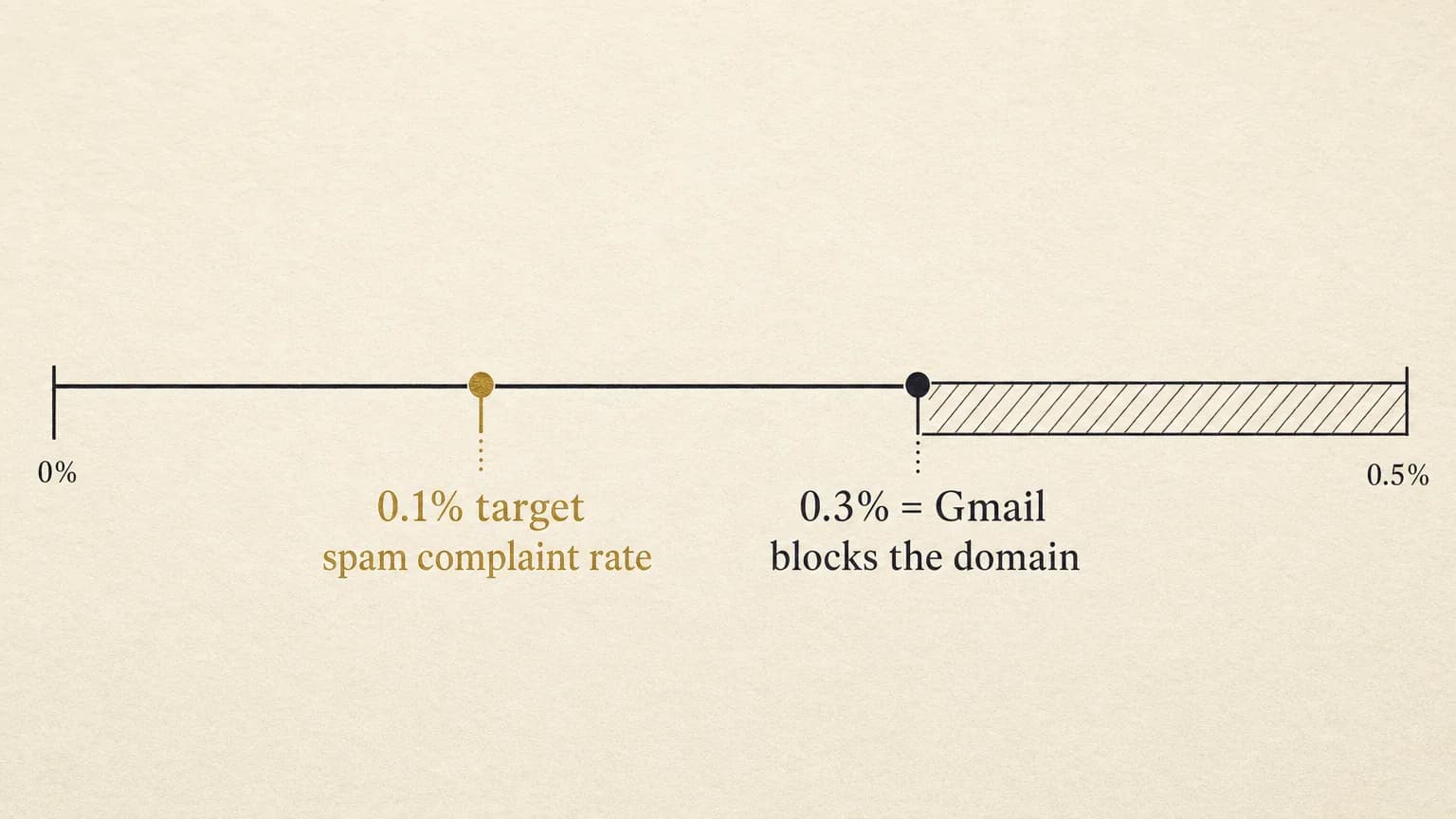
Google and Yahoo both now enforce hard rules on anyone sending outreach at meaningful volume. Per Google's own bulk sender guidelines, senders are expected to keep spam complaints under 0.1%, and once a domain's complaint rate hits 0.3% or higher, Gmail blocks it outright — authentication or not.
The practical fixes are unglamorous but non-negotiable:
- Send outreach from a subdomain, not your main company domain — so a reputation problem in your outreach never touches the inbox your invoices and customer replies depend on.
- Authenticate with SPF, DKIM and DMARC. All three, aligned, or filters treat you as unverified by default.
- Warm the domain up gradually. A brand-new domain sending thousands of cold emails on day one looks nothing like normal human sending behaviour, because it isn't.
- Give a genuine, working opt-out, and act on it immediately when someone uses it.
None of this is exciting to set up. It's also exactly the kind of one-off-then-invisible technical task that back-office automation exists for — get it configured properly once rather than re-learning it every time deliverability quietly drops.
Is any of this actually legal in the UK?
Yes, with a distinction worth knowing before you send anything. Under the UK's Privacy and Electronic Communications Regulations (PECR), the ICO's guidance on business-to-business marketing draws a line between two kinds of recipient:
- Corporate subscribers — limited companies, LLPs, and similar — can be sent unsolicited marketing email without prior consent, as long as you don't disguise who you are and you give a clear, working way to opt out.
- Individual subscribers, which under PECR includes sole traders and some partnerships, are treated the same as consumers — meaning you generally need consent or a genuine soft opt-in before emailing them.
If your outreach targets registered companies and you're transparent about who you are, you're on solid ground. If your list includes sole traders, that's the bit worth checking against the ICO's actual guidance rather than assuming "it's B2B so it's fine" covers everyone on your list.
A follow-up cadence that gets replies, not unsubscribes
Most of the value in outreach comes from the follow-ups, not the first email — which is the opposite of how most people treat it. One message, silence, nothing. Here's a cadence that covers the ground without becoming the reason someone blocks your domain:
- Email one — the observation, the problem, the low-commitment ask.
- Day 3–4 — a short, genuinely different nudge. Not "just bumping this," a new angle or a relevant detail you left out first time.
- Day 8–10 — the "wrong person?" email. Ask if there's someone better placed to speak to — it reads as considerate, not pushy, and often gets a reply purely because it's easy to answer.
- Day 16–18 — a genuine last touch, low-pressure, after which they move off active outreach rather than getting chased indefinitely.
Three to five touches over two to three weeks, each one different rather than a repeat of the last. The moment someone does reply, treat it like any other warm enquiry, not a cold one — the same speed-to-reply logic behind what speed to lead is and why it matters applies here too: a prospect who replies to cold outreach and then waits three days for your response has effectively gone cold again. In practice that means routing the reply straight into the same fast, qualifying conversation instant lead capture gives an inbound enquiry — outreach got them talking, but following up with leads automatically is what keeps them talking.
Where AI outreach genuinely helps — and where it makes things worse
Most b2b outreach tips either ignore AI entirely or treat it as a magic "personalise at scale" button. Neither is right. AI outreach is good at exactly two parts of the job: research (pulling together what's public about a company before you write to them) and structure (getting a consistent, well-formed message out fast so you're not starting from a blank page each time). It's bad at the part that actually earns a reply — sounding like it came from a specific person who looked at a specific business, rather than a template with the name swapped in.
The businesses getting AI outreach wrong right now are the ones using it to write and send the entire sequence untouched, at volume, with no human checking whether the "personalisation" is actually true. The businesses getting it right use AI for the repetitive scaffolding and keep a real person (or a genuinely well-briefed AI agent working from real account research) responsible for the one sentence that has to be true.
The takeaway checklist
- Relevance over volume. A smaller, genuinely well-matched list beats a bigger, vague one every time.
- One true sentence, not a merge tag. That's the whole job of personalisation — everything else can be templated.
- A low-commitment ask. A one-line reply, not a 30-minute call, from a total stranger.
- A separate, authenticated, warmed-up domain. Non-negotiable past a handful of emails a week.
- Three to five follow-ups, each genuinely different, over two to three weeks — not one email and silence, not a daily nudge.
- Corporate subscribers only, if you're not seeking consent — check the ICO's guidance before including sole traders on a UK list.
The bottom line
Cold outreach isn't dead, and it was never really about permission in the first place. It's about whether the person on the other end can tell, in about two seconds, whether you looked at their business or just their job title. Fix relevance, fix the ask, fix the technical setup, and stay inside the rules that actually apply to who you're emailing — and outreach to people who've never heard of you keeps working exactly as well as it always did.
If building and running that outreach yourself isn't where your time is best spent, that's the job Axivon's managed outreach does — a genuinely researched, properly configured pipeline instead of a mail-merge blast, so your reply rate depends on relevance, not luck. And if outreach isn't obviously the leak — if enquiries are already arriving and going cold instead — the Revenue Leakage Review is built to tell you which end of the funnel is actually costing you money, using your own numbers. Otherwise, get in touch.
Frequently asked questions
Axivon
Stop losing leads to missed calls and slow follow-up.
Axivon builds AI voice agents, lead capture, and follow-up automation that work while you don't. See what it would look like for your business.