How to Follow Up With Leads Automatically
Most leads don't die from lack of interest — they die from slow, inconsistent follow-up. Here's how to automate it properly, with or without a CRM.

TL;DR
Leads don't go cold because they stopped caring — they go cold because nobody replied fast enough, or replied once and then went quiet. The fix isn't "try harder to call people back." It's an automatic system that replies within minutes, asks the right qualifying questions, follows up 4–6 times over two weeks without you lifting a finger, and hands the real conversation to a human the second it gets specific. Businesses that do this convert leads that businesses without it simply lose.
The lead isn't the problem — the reply time is
Here's the uncomfortable bit: most businesses that think they have a "lead generation problem" actually have a follow-up problem. The enquiries are already arriving. They're just dying in an inbox, a missed call, or a "we'll get back to you" that quietly never happens.
That said, follow-up only works on leads you actually capture in the first place — a short, well-placed form or a chat option that doesn't scare people off matters just as much as what happens after. If your website's the leaky part of the funnel, see how to capture more leads from your website first.
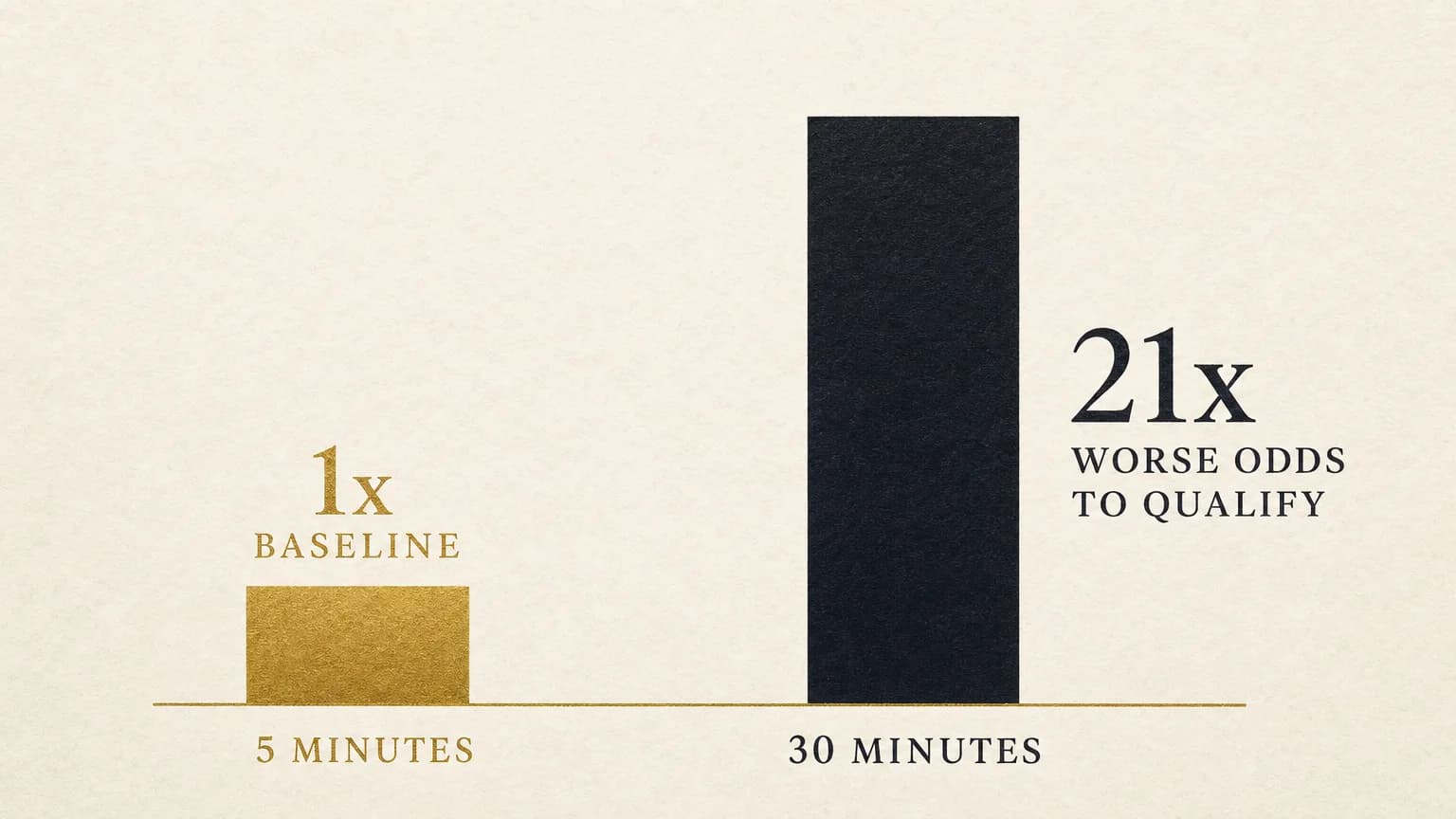
The data on this is blunt. The widely-cited Lead Response Management study published in Harvard Business Review found that the odds of properly qualifying a lead drop by roughly 21x if you wait 30 minutes instead of 5. Not 21% — 21 times worse. Most small businesses aren't checking their enquiry inbox every 5 minutes between jobs, and nobody's blaming you for that. But it does mean the current setup — a human, a phone, and good intentions — is fighting a battle it structurally can't win.
What "automatic follow-up" actually means
This isn't a 12-step drip campaign that makes you sound like a robot with a newsletter. A proper automated lead follow-up system does four things:
- Replies within minutes, not hours — usually the single biggest lever you have.
- Asks the qualifying questions a good salesperson would ask anyway (job type, timing, budget ballpark) through natural conversation.
- Follows up on a sensible cadence if the lead goes quiet — a nudge, not a barrage.
- Stops immediately and hands over to a human the moment the conversation needs real judgement, a quote, or a booking.
Notice what's missing: nobody's typing these replies live at 9pm on a Tuesday. That's the point.
Do you need a CRM first, or is that overkill?
A common question before automating anything: "don't I need a CRM to do this properly?" Not necessarily. A CRM is one way to trigger sequences, but it's built to manage pipelines, not to have a natural conversation with a brand-new enquiry. For a small, owner-run business, a purpose-built follow-up system can handle the instant reply, the qualifying back-and-forth, and the booked appointment — without you first learning, configuring, and paying for an entire CRM stack you may only use 20% of.
If you already run a CRM and it's working, plug automation into it. If you don't, don't let "I should probably get a CRM" become the thing that delays you fixing the actual problem, which is response speed.
If you'd rather not wire any of it together yourself, that's the job an AI automation agency does — though a good one should tell you when a tool you already pay for would do.
The same question comes up one rung further along, once the work is won and you're juggling jobs rather than enquiries. We've set out when workflow management software is genuinely worth it and when it's overkill — the honest answer is that team size is a much weaker signal than most buying guides pretend.
Can AI really do this without feeling like a robot?
This is the objection we hear the most, and it's a fair one — nobody wants their business to sound like a phone tree. Done properly, though, the goal isn't "look, a robot answered" — it's that the lead gets a fast, natural reply and never feels fobbed off. A well-built AI follow-up:
- Replies in your voice and tone, not a generic template.
- Asks one thing at a time, like a person would, instead of a wall of questions.
- Escalates to a human the instant the conversation gets specific — a tricky price question, a complaint, anything with nuance.
The businesses that get this wrong are the ones that automate the entire conversation and never let a human back in. The businesses that get it right automate the boring, repetitive 90% and keep a person for the bit that actually needs one.
Channel matters as much as timing here. Plenty of UK customers will ignore an email and reply to a WhatsApp message within minutes — we've covered what WhatsApp automation can and can't do for lead capture, including where it stops being useful.
A follow-up cadence that works (without being a pest)
You don't need a 15-step nurture sequence. You need a rhythm that covers two failure modes: replying too slowly (lead's gone cold) and following up too often (lead's now annoyed).
- Minute 1–5 — instant acknowledgement. Confirms you got the enquiry and starts the qualifying conversation before they've even considered a competitor. That five-minute window isn't arbitrary — the research behind speed to lead is worth reading if you want the actual numbers.
- Day 2 — the first proper nudge, if they've gone quiet, with something useful attached (availability, a relevant example of past work).
- Day 5–7 — the check-in, offering a call or clarifying scope.
- Day 12–14 — the final, low-pressure close-out, after which they move to a longer-term list rather than getting chased weekly forever.
Four to six touches, spread over two weeks, starting within minutes rather than hours. That's the whole system.
Why leads go cold (it's rarely disinterest)
If a lead never replies again, the tempting conclusion is "they weren't serious." Usually that's wrong. More often:
- Nobody replied for hours, so they moved to the next result on Google.
- The first reply was a generic "thanks, we'll be in touch" with no next step.
- One follow-up happened, it got no response, and everyone quietly gave up.
None of those are the lead's fault. They're the follow-up system's fault — or the lack of one. Which is, encouragingly, the easiest part of this whole problem to actually fix.
The bottom line
Interested people go with whoever answers first. Not whoever has the best price, the nicest van, or the longest track record — whoever replies while the enquiry is still warm. Automate the speed and the cadence, keep a human for anything that needs real judgement, and you'll start converting leads you're currently writing off as "just not that interested."
If the leads you're losing never even reach a human — a missed call, a form nobody checks until Monday — start with how to stop missing customer calls. And if the lead already got as far as a quote and has gone quiet, that's a slightly different problem: see how to follow up after sending a quote.
Want every enquiry answered in minutes and followed up automatically, in your voice, without a CRM to configure? See how Axivon's lead follow-up works, or pair it with an AI voice agent so calls and web enquiries get the same speed. Get in touch.
One honest caveat on all of this: faster follow-up only helps if enquiries are arriving in the first place. If the real problem is that the pipeline is thin rather than leaky, no follow-up system will fix it — that's an outbound conversation instead, and worth doing properly rather than as a mail-merge blast — see cold outreach that doesn't feel spammy for what that actually looks like. The Revenue Leakage Review exists partly to tell you which of the two you've actually got, because the answer decides where the money should go.
Frequently asked questions
Axivon
Stop losing leads to missed calls and slow follow-up.
Axivon builds AI voice agents, lead capture, and follow-up automation that work while you don't. See what it would look like for your business.