How to Reduce No-Show Appointments
How to reduce no-show appointments: what actually works, backed by real UK data — reminders, deposits, policy — and what mostly just adds friction.

TL;DR
Here's how to reduce no-show appointments without turning it into a full-time job: automated reminders are the single biggest lever — a randomised study out of Imperial College London found text reminders alone cut no-shows by 38%. After that: make rescheduling genuinely easy, take a deposit for anything high-value, write your cancellation policy down somewhere a customer actually sees it, and follow up within the hour when someone does miss a slot. None of it needs a rota of people manually chasing — it needs to run on its own, every time, which is exactly the kind of boring, repetitive job automation is good at and people are bad at sustaining.
The gap in your calendar is more expensive than it looks
A no-show doesn't announce itself. There's no complaint, no bad review, no angry email — just a slot that sat there, unpaid, while you could have filled it with someone who'd have turned up.
That quietness is exactly why it's easy to underestimate. Analysis of over three million UK appointments booked on Fresha between May and August found 3.8% of all bookings failed to show up, costing hair and beauty businesses an estimated £2.6 million across that single four-month window. Barbershops came out worst by some distance, at 21.16% — roughly one in five bookings — while beauty, nail and hair salons sat closer to 3–4%.
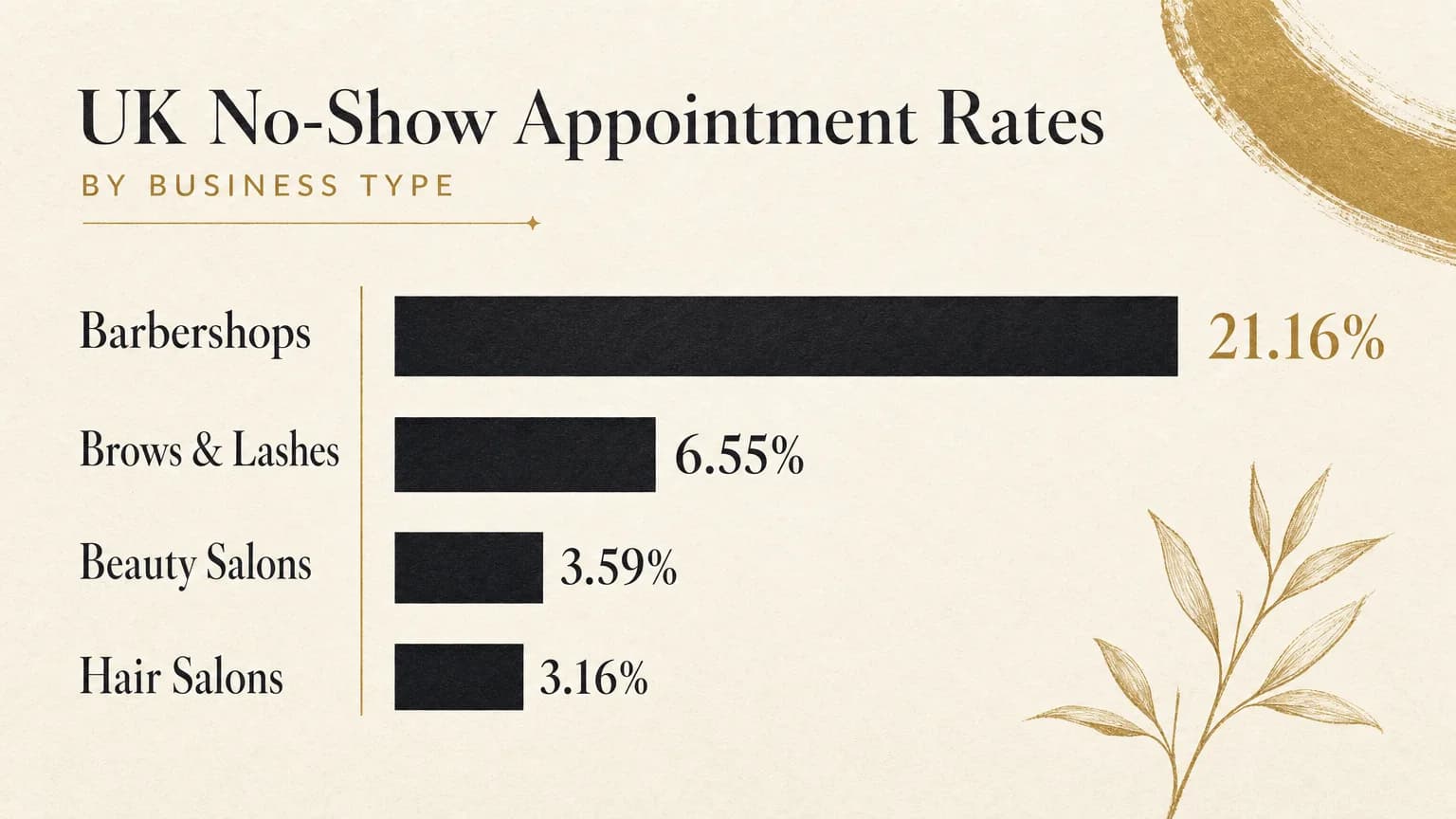
The knock-on effect is real money, not an abstract inconvenience: a separate survey of UK beauty and wellness businesses found 56% say cancellations cause significant income loss, and 51% say it makes it genuinely difficult to cover business expenses that month. If you run any kind of appointment-led business — trade, clinic, salon, consultancy — the maths is the same shape even if your numbers differ: every empty slot is a slot you turned someone else away for.
Work out your actual rate before you fix anything
Before reaching for a fix, spend five minutes on the number itself. Divide missed appointments by total booked appointments over the last month — most booking software already logs this, even if nobody's looked.
That number tells you two things: whether you actually have a problem worth solving (some businesses assume the worst and are fine), and roughly where you sit against your sector. If you're a hair salon running at 3% you're in line with the UK average above. If you're running at 10%, something in your booking or reminder process is genuinely broken, not just bad luck with clients.
Why people actually miss appointments
It's tempting to file every no-show under "some people just don't care." Most of the time that's wrong, and it's worth knowing why before you start designing fixes around the wrong assumption.
The honest breakdown looks more like this:
- They forgot. Not carelessness — a booking made weeks ago competing with everything else in someone's week. This is the majority of cases, and it's also the easiest to fix.
- Something came up. Work ran over, the car wouldn't start, a kid was sent home from school. Life doesn't check your diary before it happens.
- Cancelling felt like more hassle than not showing. If the only way to cancel is a phone call during your business hours, plenty of people will simply not turn up rather than make it.
- Genuine avoidance. For anything that carries a bit of dread — a dental check-up, a difficult conversation, a first appointment somewhere new — some no-shows are quiet avoidance rather than a scheduling slip. A friendlier, lower-pressure reminder helps here more than a stricter policy does.
None of those four are "the client doesn't respect your time," which is the assumption most no-show advice quietly leans on. Design for forgetfulness and friction first — that's most of the problem — and the policy and deposit tools further down are for the smaller remainder that isn't. There's no single trick that will prevent no-show appointments outright; it's a handful of small, boring fixes stacked on top of each other, most of which also reduce cancellations turning into total losses by giving people an easy way to rebook instead of just vanishing.
The single biggest lever: reminders people actually see
Here's the uncomfortable bit for anyone still relying on "we tell them the date when they book and hope for the best": a booking made three weeks ago is not front of mind on the day, and it's nobody's fault when they forget — it's just how memory works.
The fix isn't more willpower from your customers. It's a reminder that lands close enough to the appointment to actually be useful. The evidence for this is unusually solid for a marketing claim: a randomised controlled trial from Imperial College London's Department of Primary Care and Social Medicine found that a simple text message reminder cut no-show rates by 38% compared with sending nothing at all. Not a projection from a booking-software sales page — a proper study, with a control group.
What makes reminders work is timing and channel, not cleverness:
- Send more than one, at different points. A confirmation the day of booking, then a reminder 24–48 hours out, catches people at two separate moments instead of relying on one message surviving three weeks in a crowded inbox.
- Text beats email for read rate, and both beat a phone call for cost — though a call still earns its place for higher-value or unusual bookings, more on that below.
- Ask for confirmation, not just delivery. A reminder that requires a tap to confirm gives you an early warning if someone's not coming, while there's still time to fill the slot from a waitlist.
The part that actually breaks this in practice isn't knowing it works — it's sustaining it. Manually texting every client the day before, every week, forever, is the kind of task that gets skipped the first time you're genuinely slammed, which is exactly the week you can least afford the no-shows. That's a job for automated appointment reminders running on their own, not a standing task on someone's to-do list — set it once against your booking calendar and it runs whether or not anyone remembers.
Make cancelling or rebooking a two-tap job
A customer who genuinely can't make it will often just... not show up, rather than phone during business hours to cancel — not out of rudeness, but because calling to cancel feels like more admin than the appointment was worth.
Give them a way out that's easier than ghosting you. A reschedule or cancel link in the reminder itself — no login, no hold music, no "we're currently experiencing high call volumes" — turns a no-show into a cancellation you can actually fill, and a cancellation you can fill is a much smaller problem than an empty slot you find out about when nobody arrives.
Deposits and pre-payment: worth the friction, sometimes
Deposits work less because of the money and more because of the commitment. Someone who's put a card down — even a modest £10–£20, or just a hold rather than a charge — has made a small psychological bet on turning up, and people are reliably more likely to honour a bet than a free booking.
That said, it's not free to add friction to every booking. A £15 haircut with a deposit form attached will lose you bookings to the salon down the road that doesn't ask. The honest rule: reserve deposits for bookings that are high-value, in-demand, or from a client who's already no-showed once. Blanket deposits on everything solve a no-show problem by creating a different one.
Write the policy down before you need it
A cancellation policy only works if a customer has actually seen it before they need it — not buried three clicks deep in your terms and conditions, discovered for the first time in an argument.
Keep it short and plain: how much notice you need (24–48 hours is standard across most UK service businesses), and what happens if they don't give it — a fee, a forfeited deposit, or simply a note that a second no-show means a deposit's required next time. Say it once, kindly, at the point of booking. The point of a policy isn't to punish people; it's to set an expectation clearly enough that most people meet it without you ever having to enforce the consequence.
What to do the moment someone doesn't show
The instinct is to write the slot off and move on. Don't — contact them the same day, ideally within the hour, while it's still fresh and easy to fix.
Most no-shows aren't defiance. They're a forgotten reminder, a diary clash, a kid who was sick. A quick, friendly "looks like we missed each other today — want to grab another slot?" recovers a genuine share of that lost booking, and it's the same speed-beats-nothing logic that applies to chasing any lead that's gone quiet — the business that follows up fastest usually wins the rebooking, same as it wins the first booking. It also quietly tells you, over a few instances, which clients are worth a deposit requirement going forward and which just had a bad week.
How to reduce no-show appointments: the checklist
- Pull your actual no-show rate for the last month — most booking software already has it logged.
- Turn on a two-stage reminder — booking confirmation plus a text 24–48 hours out — if you're not already sending one.
- Add a one-tap reschedule/cancel link to that reminder.
- Write your cancellation policy in two sentences and put it where people book, not just in the small print.
- Follow up same-day, every no-show, without exception — it's the step that's easiest to skip and the one that recovers the most.
None of that needs new software if you're already running a decent booking system — it mostly needs someone to actually turn the reminder and follow-up settings on and leave them running. If your current setup makes that harder than it should be, that's usually an admin problem worth fixing on its own terms, and we've written about when it's actually worth a proper system versus when a spreadsheet is still fine.
The bottom line
No-shows aren't a discipline problem on your customers' side — they're a communication problem on yours, and it's the kind that automation fixes better than a person ever will, because it never forgets to send the text on a busy Friday. Turn reminders on, make cancelling easy, reserve deposits for where they actually earn their keep, write the policy down, and follow up fast when someone still misses a slot. Get the boring parts running automatically and the number takes care of itself.
It's the same principle behind answering every call instead of losing a quarter of them to voicemail — the fix for a silent, invisible leak in revenue is rarely trying harder. It's building something that runs the same way every single time, whether you remember to or not. If you're not sure how much your calendar is actually leaking, get in touch and we'll help you work it out, or start with the Revenue Leakage Review if you'd rather have the whole customer journey — not just the diary — properly mapped first.
Frequently asked questions
Axivon
Stop losing leads to missed calls and slow follow-up.
Axivon builds AI voice agents, lead capture, and follow-up automation that work while you don't. See what it would look like for your business.