Virtual Receptionist for Small Business: Worth It?
Is a virtual receptionist for small business worth the cost? Real UK pricing, what you actually get, and the honest test for when it pays for itself.

TL;DR
A virtual receptionist for a small business typically costs £65–£300 a month for a human service, or £25–£200 for a usage-priced AI one — against £18,000–£31,000 a year for an in-house hire before National Insurance and pension. It's worth it when the calls you're currently missing are worth more than that monthly fee, and it usually is, for the same reason most small businesses lose calls in the first place: nobody's paid to sit by the phone all day waiting for it to ring. Below: what "virtual receptionist" actually means now that the term covers both humans and AI, what you're really paying for, and an honest five-minute test for whether it's worth it for your business specifically.
What "virtual receptionist" actually means
Ask ten providers what a virtual receptionist is and you'll get ten slightly different answers, which is unhelpful when you're trying to work out if you need one.
Strip away the marketing and it means one thing: someone (or something) answers your business calls without being physically in your building. That's it. Everything else — human or AI, message-taking or booking, £15 a month or £300 — sits underneath that one definition.
The confusion comes from two directions at once. Traditional providers have used "virtual receptionist" and "answering service" interchangeably for years, so you'll find the same company listed under both. And more recently, AI voice agents have started calling themselves virtual receptionists too, because functionally they do the same job — answer the phone in your name — just without a person on the other end. We build the AI virtual receptionist, so we're not neutral on which is better, but the honest starting point is that "virtual receptionist" today is a category, not a single product, and the worth-it question depends entirely on which one you're actually pricing up.
How it works, day to day
Set-up is almost always the same regardless of which type you pick.
You divert your business number to the provider (your existing number stays the same — callers never know it moved). You brief them: opening hours, pricing, what genuinely counts as urgent, what to do with a job you can't take this week. From then on, calls route to them the moment you're unavailable, or all the time if that's the plan you're on.
What happens next depends entirely on what you're paying for. A basic message-taking plan gets you a note in your inbox and a callback still on your to-do list. A fuller service — human or AI — answers the caller's actual question and books the appointment straight into your calendar, which is a meaningfully different outcome for a caller standing in their kitchen deciding whether to try the next name on the list.
What it actually costs — the short version
UK virtual receptionist pricing lands in fairly predictable bands. Human virtual receptionist plans run roughly £65–£300 a month for business-hours cover, climbing past £300 for genuine round-the-clock service. Usage-priced AI agents typically run £25–£200 a month, because there's no rota to fund and no idle time between calls to pay for.
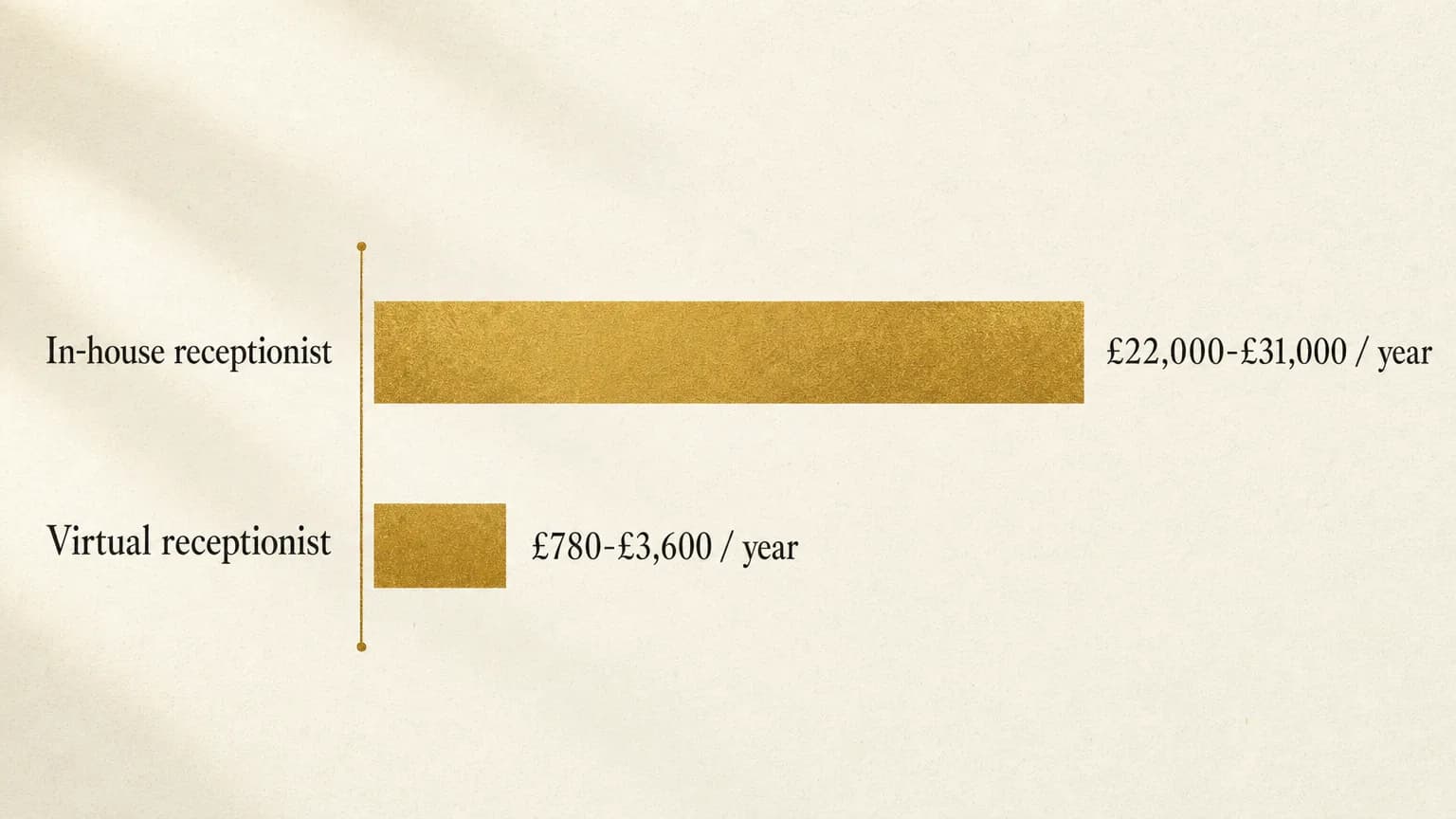
That's a genuinely large gap. An in-house receptionist's salary alone sits somewhere between £22,000 and £31,000 a year depending on which UK salary source you check, and that's before employer National Insurance and a workplace pension add roughly 15–20% on top. A mid-range virtual receptionist plan at £150 a month comes to £1,800 a year — under a tenth of the cheapest in-house salary figure, and it never calls in sick or hands in its notice.
We've published the full pricing breakdown — every published UK provider rate we could find, and the fees that don't show up on the pricing page — in answering service pricing, and the complete in-house comparison with the employer NI detail most articles get wrong in AI receptionist vs human receptionist. This post isn't repeating that maths; it's answering the question that comes before it — whether it's worth doing at all.
What you're actually paying for
The monthly fee buys more than "someone picks up the phone." Three things tend to matter more than the headline price:
- Coverage you can't otherwise afford. One employee gives you roughly 40 hours a week. A phone rings for 168. Covering the gap with staff means shift patterns, overnight rates, or simply accepting the phone goes unanswered outside 9-to-5 — which is exactly when a fair share of enquiries land, particularly for trades and anything urgent.
- Consistency. A receptionist takes lunch, holiday, and the odd sick day, and every one of those is a gap a caller falls through. A virtual receptionist — human rota or AI — doesn't have an off day, which matters more than it sounds until you count how many calls a genuinely busy fortnight actually loses to exactly that.
- Your own time back. For an owner currently answering their own phone between jobs, the value isn't just the calls that get answered better — it's the ones that stop interrupting you mid-task. That's real, even though it doesn't show up on an invoice.
None of that means every plan is worth its price. A bargain plan that only takes a message and leaves the booking to you is worth roughly what a bargain human answering service is worth — better than voicemail, some way short of finished. Which is really the honest answer to "what's the best virtual receptionist for small business use": there isn't a single one — there's the one that matches whether you need a message taken or a job booked, and at what hours.
Where it's clearly worth it
The pattern holds across most owner-operated and growing service businesses: your calendar is the engine of revenue, calls are frequent and mostly routine — pricing, availability, "can you come Thursday?" — and a meaningful share land outside your working hours. Trades, clinics, salons, and appointment-led professional services all fit this shape.
Research across UK SMEs puts the missed-call rate at roughly 1 in 4, rising to 47% for first-time enquiries — and fewer than 3% of callers pushed to voicemail ever leave a message. If your average job is worth £300 and you close half of the people who reach you, five missed calls a week is over £1,800 a month, quietly gone. We've done that sum properly, with the working shown, in how to stop missing customer calls. Against that kind of number, a £150-a-month plan clears its cost in the first week most months.
Where it isn't
Being honest about the other side matters, because "always worth it" is marketing, not advice.
If your phone genuinely doesn't ring much, or you already answer nearly every call yourself without much friction, there's very little for a virtual receptionist to recover — you'd be paying to solve a problem you don't actually have. And if most of your calls are emotionally complex — a distressed customer, a sensitive complaint, a negotiation that isn't really about the stated question — a script (human or AI) tends to fall short of a person who knows the business and can use judgement. That's not a knock on virtual receptionists specifically; it's just not what the format is built for.
Virtual receptionist vs hiring in-house — the quick version
Cost aside, the honest trade-off is this: an in-house hire brings context and judgement no outsourced brief fully replicates, and is the better choice once your call volume and complexity genuinely justify a full-time role. A virtual receptionist wins on cost, coverage hours, and consistency — no rota gaps, no single point of failure — right up until that volume tips.
Most growing businesses don't actually face a binary choice. The common setup is a virtual receptionist (often the AI kind, for cost reasons) handling the routine and out-of-hours volume, with a person stepping in for anything that genuinely needs one — which turns your existing team's time into judgement work instead of switchboard duty, if you have staff already.
The five-minute test
Before you price anything up, do this instead of reading another comparison article:
- Pull your real call volume for a fortnight. Most phone systems log missed and answered calls — check the actual number, not a guess. Most owners underestimate it.
- Work out what one answered call is worth. Average job value × the rate you close people who reach you gets you close enough.
- Multiply your missed calls by that figure. That's your monthly leak — the number a virtual receptionist has to beat.
- Check the shape of your calls. Mostly routine — hours, pricing, "can you come Thursday" — favours a virtual receptionist. Mostly sensitive or negotiation-heavy favours keeping a person on the line.
- Compare the leak to a realistic UK price band: £65–£300 a month human, £25–£200 a month AI, from the numbers above.
If the leak is bigger than the cost, the answer is yes before you've called a single provider.
The bottom line
A virtual receptionist for a small business is worth the cost for most businesses currently losing calls they'd rather keep — the monthly fee is a fraction of an in-house salary, and the coverage gap it closes (evenings, weekends, the moment you're on a job and can't answer) is exactly where calls tend to go missing. It's not worth it if your phone rarely rings, or if most of your calls need a person's judgement more than they need someone to answer at all.
If you want to see the real number for your own call volume rather than a UK-wide average, take a look at our AI voice agents or get in touch and we'll work the maths with you. And if calls are only one part of where enquiries are slipping through, the Revenue Leakage Review scans the whole customer journey — including lead follow-up and the admin after the call — and tells you which gap is actually costing you most.
Frequently asked questions
Axivon
Stop losing leads to missed calls and slow follow-up.
Axivon builds AI voice agents, lead capture, and follow-up automation that work while you don't. See what it would look like for your business.