AI Receptionist vs Answering Service
Comparing an AI receptionist vs answering service? Here's the real difference in cost, speed and availability — plus when a human service still wins.

TL;DR
An answering service puts a human operator on the other end of your calls; an AI receptionist puts software there instead — one that can actually answer questions about your business, not just take a message. On cost, an AI receptionist usually comes out level or cheaper once you factor in 24/7 cover and overage minutes. On availability, it wins outright: no rota, no hold queue, no "sorry, all our operators are busy." Where a human still earns their keep is genuine judgement calls — a furious customer, an unusual request, a VIP who wants to be recognised. Most businesses end up running both: AI on the front door, a human for the bit that actually needs one.
What's actually different (not just "one's a robot")
Strip away the marketing and the comparison is simple. An answering service is a human operator, usually working for a call centre you'll never visit, who picks up your calls under your business name. They take a message, maybe check basic availability, and pass it on. That's the job — and it's a perfectly reasonable one.
An AI receptionist is software briefed on your business: your services, your pricing, your hours, your cancellation policy, your calendar. It doesn't just take a message — it answers the question, books the slot, and only escalates when something's genuinely outside its brief. That's the practical difference between "I'll pass that on" and "yes, we do that, and Thursday at 2pm works — shall I book you in?"
Neither is inherently better in the abstract. The right one depends on what you actually need answered.
The real cost comparison
This is where most comparison posts get vague, so here are the actual UK numbers. A basic live answering service typically runs £80–£150 a month, climbing past £300 once you add proper 24/7 cover, overage call charges, or diary management add-ons — because every extra hour needs an extra person paid to sit by a phone. An AI receptionist tends to sit in a similar or lower monthly range, but the number rarely moves for adding weekends, bank holidays, or a surge of calls, because there's no rota to expand.
The honest caveat: cheap isn't automatically better. A £50-a-month bare-bones plan on either side will be worse than a properly configured £150-a-month one. Compare like for like — hours covered, calls included, what happens on overage — not just the headline price.
For a like-for-like UK comparison, our answering service pricing UK guide sets out published per-call, per-minute and monthly rates, including the fees that rarely make the headline.
For the full pricing breakdown — off-the-shelf tiers, custom-build costs, and the setup fees and overage rates most comparison posts leave out — see how much does an AI receptionist cost.
Availability is where the gap actually shows up
Cost gets the headlines, but availability is the bigger practical difference. An answering service's coverage is only as good as its rota: hours vary by plan, out-of-hours cover usually costs extra, and busy periods mean your caller joins a queue behind someone else's caller. An AI receptionist doesn't have a shift pattern. 3am is the same as 3pm. Ten calls at once get answered ten times, not queued once.
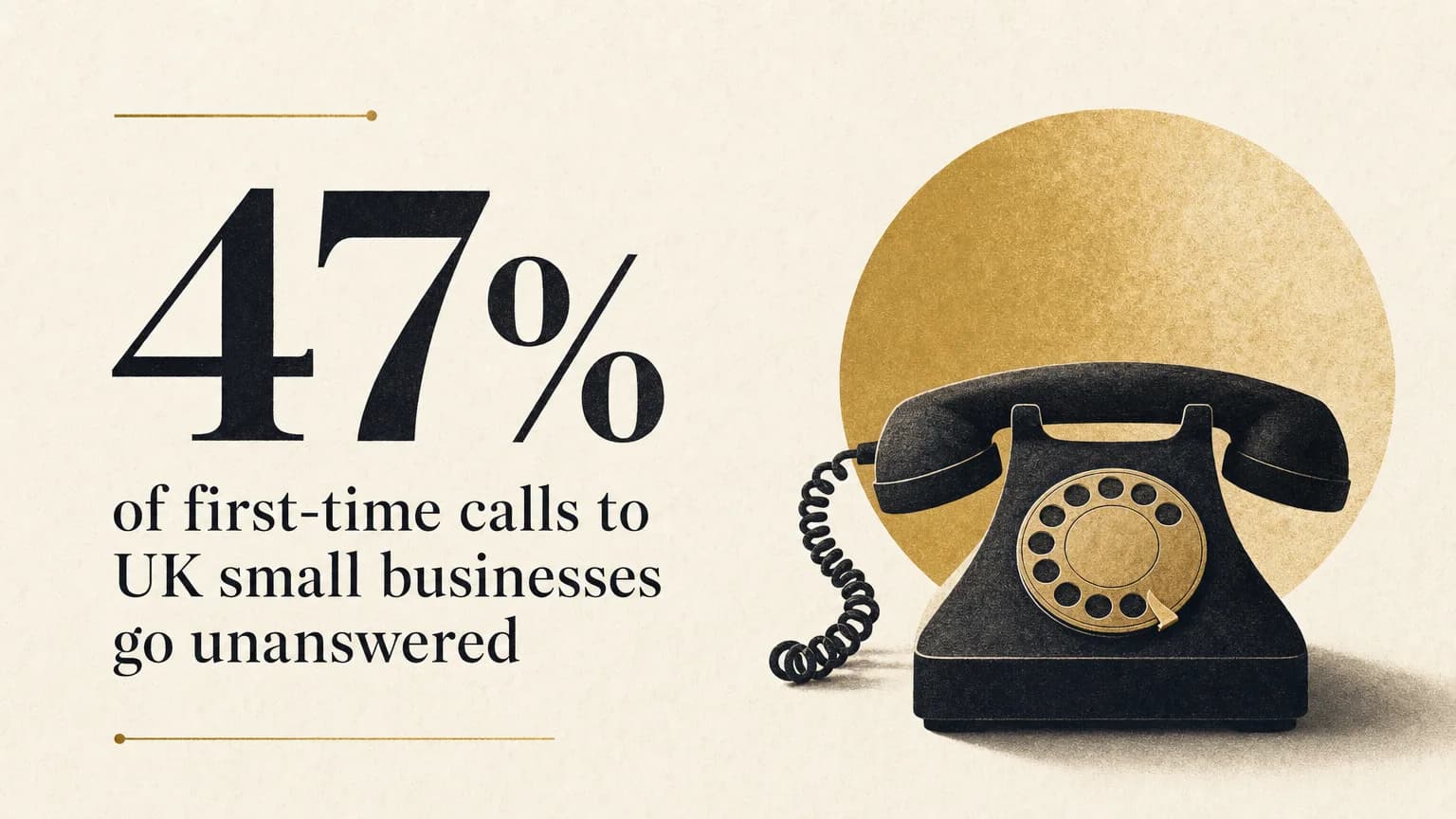
That matters more than it sounds. A 2025 study of 142 UK SMEs found that 47% of first-time calls went unanswered — and independent research puts the broad small-business average closer to 1 in 4, rising to 35–40% for sole traders during busy periods, according to analysis compiled by Paperclip. Most of those callers don't leave a voicemail. They call the next name on the list. Whichever option you pick, "does it actually pick up every time" should outrank "does it sound impressive."
Where a human answering service still wins
None of this makes AI the right call for every business or every situation. A human is still better at genuine emotional judgement — a distressed customer, a complaint that needs real empathy, a negotiation that isn't really about the stated question. If a meaningful share of your calls are like that, a human answering service (or a hybrid) earns its cost.
The mistake is assuming every call needs that. Most calls to most small businesses are routine: "are you open Saturday," "how much does X cost," "can I book Thursday." Those don't need judgement. They need a fast, accurate answer — which is exactly what AI is built for.
Is accuracy actually a worry?
It's the fair objection, and worth taking seriously rather than waving away. A poorly built AI receptionist absolutely can mangle a booking or give a wrong price — same as a poorly trained new hire on their second day. The difference is what happens when it's built properly: it's briefed on your actual services and calendar, it says "let me check that" rather than guess, and it hands over to a human the moment a question falls outside its brief.
Done well, the goal was never "look, a robot answered." It's that the caller got helped, booked, and never felt fobbed off — which, incidentally, is a higher bar than most human answering services clear on a Friday afternoon with three lines ringing at once.
Worth being clear about scope here: this post compares an AI receptionist against an answering service — a call centre operator taking messages for you. If you want the wider view first, the telephone answering service buyer's guide covers what they cost, how to choose one, and the four realistic ways to cover a ringing phone. If what you're actually weighing up is hiring your own receptionist, that's a different sum with different numbers, and we've done it properly in AI receptionist vs human receptionist, including real UK salary data and the employer National Insurance detail most comparisons skip.
Which one should you actually pick
A short, honest checklist:
- Mostly routine calls (hours, pricing, booking, availability) → an AI receptionist handles this well and cheaper than most people expect.
- Regular emotionally complex calls (complaints, sensitive queries, negotiations) → keep a human in the loop, either full-time or as the escalation path.
- After-hours and weekend calls matter to your business → AI wins outright here; humans cost extra for exactly the hours you can't be reached.
- You're not sure which → most growing businesses land on a hybrid: AI answers first, qualifies, books what it can, and hands anything genuinely tricky to a person — which is how we set up Axivon's AI voice agents by default.
Still weighing up whether to spend the money at all? The break-even sum — what it actually costs against what a missed call actually costs you — is worked through properly in is an AI phone agent worth it for a small business.
The bottom line
An answering service buys you a human on the other end of the phone. An AI receptionist buys you an answer, every time, at a fraction of the cost of covering every hour with a person. For most growing businesses handling routine enquiries — bookings, pricing questions, "are you open" — the AI route wins on cost and availability, with a human kept for the calls that genuinely need one.
If missed calls are the bigger issue right now rather than which answering option to pick, start with how to stop missing customer calls — the fix is usually simpler than people expect. And if admin outside the phone is also piling up, back-office automation tends to be the next lever worth pulling.
Want calls answered properly, 24/7, without hiring or a call-centre bill? See how Axivon's AI voice agents work, or get in touch and we'll show you what it'd look like for your business.
Frequently asked questions
Axivon
Stop losing leads to missed calls and slow follow-up.
Axivon builds AI voice agents, lead capture, and follow-up automation that work while you don't. See what it would look like for your business.